The right rear rack turns a bicycle into a more practical commuter, errand runner, or touring setup. Adjustable models can fit a wider range of wheel sizes and frame designs while giving you a stable platform for panniers, baskets, and strapped-down cargo.
We’ve gathered 10 adjustable bike rear racks with different strengths, including high load ratings, quick-release designs, reflective details, fenders, and broad compatibility. Use the guide below to narrow the choices by bike fit, cargo needs, and installation preferences.
Best 10 Adjustable Bike Rear Racks Picks for 2026
High-Capacity Pick
West Biking Adjustable Cargo Rack

- 110-pound stated load capacity
- Adjustable aluminum-alloy body
- Includes reflector, tools, and hardware
Best For: Heavy commuting, touring, and delivery loads
Touring Versatility

- Fits 26–29-inch and 700c bikes
- Works with disc or non-disc brakes
- Includes basket and carries up to 60 pounds
Best For: Touring, camping, and basket-equipped commuting
Universal Seat-Post Option
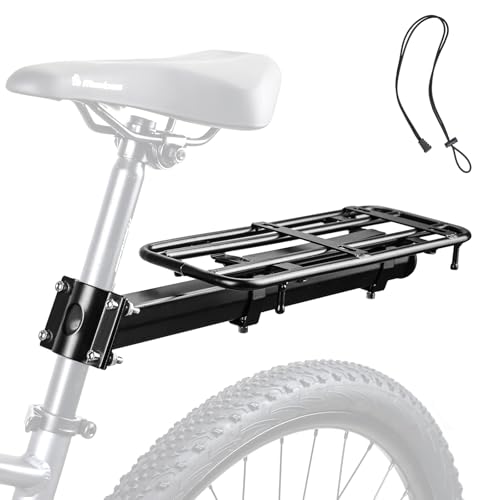
- Fits 20- to 29-inch bicycles
- Front-and-back position adjustment
- 33-pound steel rack with reflector
Best For: Moderate commuter and touring cargo
Quick-Release Choice
ROCKBROS Adjustable Cargo Rack

- Quick-release installation and removal
- 55-pound stated load capacity
- Adjustable supports with side protection
Best For: Compatible mountain bikes and removable cargo use
Best for High-Capacity Touring
Large Adjustable Rear Bike Rack

- 55-pound stated load capacity
- Adjustable arms and telescoping supports
- Large reflector and flat cargo platform
Best For: Touring and utility riders carrying panniers, bags, or baskets
Best for Seatpost Simplicity
Quick-Release Adjustable Rear Rack

- Retractable aluminum shelf
- Fits 27.2–31.8 mm seatposts
- Lightweight quick-release design
Best For: Everyday riders needing removable cargo capacity
Best for Compact Adjustable Cargo
Reflective Retractable Rear Rack

- 66-pound stated maximum capacity
- Forward/backward extendable mounting rod
- Reflector and raised cargo-retaining edges
Best For: Compatible road, mountain, and hybrid bikes needing compact storage
Best Adjustable Seatpost Rack
Outtag Retractable Aluminum Rear Rack

- Retractable shelf and adjustable mounting rod
- 55-pound stated load capacity
- Fits 27.2–31.8 mm seat tubes
Best For: Flexible everyday cargo carrying on compatible road, mountain, and fat bikes
Best Weather-Ready Rack
YONTUO Adjustable Rear Rack with Fender

- Adjustable panel and telescoping side supports
- Removable fender and large reflector
- Enlarged wings help shield panniers
Best For: Commuting and touring in wet or muddy conditions
Best Heavy-Duty Rack
YONTUO 310-Pound Adjustable Cargo Rack

- Stated 310-pound load capacity
- Quick-release clamp and adjustable supports
- Includes fender, reflector, and pannier wings
Best For: Heavy cargo loads on compatible 26- to 29-inch bike frames
High-Capacity Pick – West Biking Adjustable Cargo Rack
If you need adjustable bike rear racks for substantial loads, the West Biking model stands out with a stated 110-pound capacity and a versatile aluminum-alloy design. Its adjustable rack body and included installation tools make it practical for commuting, touring, panniers, baskets, and delivery use.
Best For: Riders who need very high carrying capacity for commuting, touring, or last-mile delivery.
Pros:
- Stated load capacity of up to 110 pounds.
- Adjustable body fits seat tubes measuring about 0.85 to 1.3 inches.
- Includes mounting hardware, tools, instructions, and a rear reflector.
- Aluminum construction works with panniers, backpacks, and baskets.
Cons:
- Not suitable for kids’ bikes or Trek Verve bikes.
- Its rear-seat mounting design requires careful compatibility checking.
- The instructions caution against carrying children directly.
The West Biking rack is a capacity-focused choice with a generous adjustment range and useful included accessories. Confirm your frame dimensions and mounting points before relying on its maximum rated load.
Touring Versatility – CXWXC Rear Rack with Basket
Among adjustable bike rear racks, the CXWXC model is aimed at riders carrying panniers and larger loads on adult bikes. It fits 26- to 29-inch wheels and 700c bikes, supports disc and non-disc brake setups, and includes a rear basket for added cargo flexibility.
Best For: Touring, camping, commuting, and riders who want both a rack and basket.
Pros:
- Compatible with 26- to 29-inch wheels and 700c bikes.
- Designed for disc and non-disc brake bicycles.
- Includes a rear basket and supports up to 60 pounds.
- 6061-T6 aluminum construction and multiple adjustment points.
Cons:
- The bicycle must have appropriate rack eyelets, or a usable T-adapter setup.
- Fasteners should be checked periodically and tightened if needed.
- At 1.36 kg, it is not the lightest option in this group.
This is a strong all-around option for riders who want pannier capacity plus a basket. Its eyelet requirement is the main fit consideration, so inspect the frame and rear-hub mounting points before ordering.
Universal Seat-Post Option – WEEROCK Adjustable Rear Rack
The WEEROCK rack offers a straightforward alternative for riders comparing adjustable bike rear racks across several wheel sizes. Its front-and-back adjustment is designed for 20- to 29-inch bicycles, while the seat-tube mounting system avoids the need for the rack eyelets used by some frame-mounted designs.
Best For: Everyday commuters and touring riders seeking a simple seat-post-mounted rack for moderate loads.
Pros:
- Designed for bicycles with 20- to 29-inch wheels.
- Front-and-back adjustment helps provide wheel and seat clearance.
- Steel construction supports up to 33 pounds.
- Includes installation tools and a rear reflector.
Cons:
- The 33-pound capacity is lower than several competing options.
- Its alloy-steel construction weighs 1.47 kg.
- Installation uses seat-tube plates and screws, which must be securely fitted.
WEEROCK is best suited to moderate cargo rather than oversized touring loads. Its broad wheel-size range and simple seat-tube installation make it a practical choice when frame-mounted eyelets are unavailable or inconvenient.
Quick-Release Choice – ROCKBROS Adjustable Cargo Rack
The ROCKBROS rack is one of the more convenient adjustable bike rear racks for riders who want quick installation and removal. It combines adjustable support rods, three-point fixation, side rails, cargo cords, and a 55-pound capacity for commuting, touring, and everyday errands.
Best For: Mountain-bike riders who want a removable rack for panniers, bags, or routine cargo trips.
Pros:
- Quick-release clamps make installation and removal convenient.
- Adjustable height, length, and angle help accommodate different frames.
- Supports up to 55 pounds when properly installed.
- Side rails, elastic cords, and a red reflector add practical cargo and visibility features.
Cons:
- Not suitable for soft-tail, carbon-fiber, folding, small-wheel, or rear-suspension bikes.
- Fits round seat tubes under 1.26 inches, so compatibility must be checked.
- It weighs 1.43 kg despite its aluminum construction.
ROCKBROS is a useful fit for compatible mountain bikes and riders who value removable hardware. Its extensive exclusions make a careful bike check essential, particularly for suspension, folding, carbon, and small-wheel models.
Best for High-Capacity Touring – Large Adjustable Rear Bike Rack
For riders comparing adjustable bike rear racks for commuting, touring, or loaded day trips, this frame-mounted aluminum rack emphasizes capacity and fit flexibility. Its adjustable arms and telescoping supports are designed for 24–28-inch and 700C bicycles, while the flat platform accommodates panniers, bags, and baskets.
Best For: Touring cyclists who need a sturdy, high-capacity rack with broad adjustment options and added nighttime visibility.
Pros:
- Aluminum construction with a durable TIG-welded and thickened frame.
- Adjustable front arms and telescoping side supports from 11 to 15.8 inches.
- 55-pound stated load capacity for luggage, panniers, backpacks, or baskets.
- Large reflector, flat top panel, stainless screws, and included tools add practical utility.
Cons:
- Frame-mounted design may require suitable rack mounting points on the bicycle.
- The rack is not intended for passengers, children, or child seats.
- Fit depends on bicycle size and the selected 9.1-inch or 12.6-inch front-arm option.
This is the most feature-rich choice of the three for riders carrying substantial gear. Confirm your bicycle’s mounting points and dimensions before buying, but the adjustable structure makes it a strong option for touring and utility use.
Best for Seatpost Simplicity – Quick-Release Adjustable Rear Rack
This seatpost-mounted option is a practical pick for shoppers seeking adjustable bike rear racks without a more involved frame installation. The retractable aluminum shelf adjusts forward or backward, fits seatposts measuring 27.2–31.8 mm, and can be removed or retracted for storage.
Best For: Riders who want a lightweight, adjustable seatpost rack for everyday cargo and occasional trips.
Pros:
- Lightweight aluminum design weighing about 1.3 pounds.
- Quick-release seatpost mounting with included rubber pads and Allen key.
- Retractable shelf helps accommodate different bikes and simplify storage.
- Raised tail and front flap help keep cargo in place.
Cons:
- Seatpost compatibility is limited to approximately 27.2–31.8 mm.
- Although the product description cites 55 pounds, the details list a 22-pound load capacity; verify the appropriate rating before loading.
- Seatpost mounting may be less suitable for loads that require a frame-supported rack.
Its straightforward seatpost installation and compact retractable design make it convenient for flexible use. Carefully check the seatpost diameter and follow the more conservative capacity information if the two listed ratings conflict.
Best for Compact Adjustable Cargo – Reflective Retractable Rear Rack
Among adjustable bike rear racks, this retractable aluminum model offers a compact seatpost-mounted setup for mountain, road, and hybrid bikes. Its extendable mounting rod changes the cargo position, and the rack adds a reflector plus raised edges to help manage loaded bags and gear.
Best For: Riders with compatible seatposts who want a lightweight, retractable rack with a high stated carrying capacity.
Pros:
- Aluminum construction with a stated maximum capacity of 66 pounds.
- Extendable mounting rod adjusts forward and backward for cargo positioning.
- Large reflector improves visibility for nighttime riding.
- Raised tail and front flap help prevent cargo from sliding off.
Cons:
- Requires a 27.2–31.8 mm seatpost and at least 2 inches of mounting space.
- Not compatible with kids’ bikes, foldable bikes, bikes under 24-inch tires, or square seatposts.
- The rack cannot carry passengers, children, or child seats.
This rack stands out for combining a retractable design with the highest stated capacity in this group. Compatibility is more restrictive than the universal wording suggests, so measure the seatpost and available mounting area carefully before purchase.
Best Adjustable Seatpost Rack – Outtag Retractable Aluminum Rear Rack
For riders comparing adjustable bike rear racks, the Outtag offers a compact seatpost-mounted design with a retractable shelf and adjustable mounting rod. Its aluminum construction, included installation tools, and stated 55-pound capacity make it a practical option for carrying panniers, backpacks, or baskets—provided your seatpost dimensions match.
Best For: Road, mountain, and fat-bike riders who want a retractable rack for day trips and general cargo hauling.
Pros:
- Adjustable shelf and mounting rod retract for fit and storage.
- Aluminum construction with stainless steel screws.
- Supports up to 55 pounds, according to the supplied specifications.
- Raised tail and front flap help keep cargo in place.
Cons:
- Fit is limited to compatible seatposts and mounting dimensions; the bracket suits 27.2–31.8 mm seat tubes.
- As a seatpost-mounted rack, capacity depends on the strength of the seatpost.
The Outtag is a straightforward choice when adjustability and easy removal matter more than a frame-specific mounting system. Check your bike’s seatpost size before ordering.
Best Weather-Ready Rack – YONTUO Adjustable Rear Rack with Fender
Among adjustable bike rear racks, this YONTUO model stands out for combining a length-adjustable top panel with telescoping side supports, a removable fender, and a large reflector. The aluminum rack is designed for panniers and other cargo, with enlarged side wings intended to help keep bags away from the spokes.
Best For: Commuters and touring riders who want adjustable cargo support plus added coverage for wet or muddy conditions.
Pros:
- Top panel adjusts from 16 to 18 inches, while side supports extend from 11 to 15.75 inches.
- Removable adjustable fender helps protect bags and clothing from spray.
- Large reflector improves visibility during night riding.
- Enlarged side wings help protect panniers from the spokes.
Cons:
- Fit requires about 2 inches of seat-tube height and a 2.2–3.3 cm seat-tube diameter.
- The supplied warranty note states that it cannot carry passengers, children, or a child seat.
This rack is a strong fit for riders who value weather protection and pannier clearance alongside adjustability. Confirm the mounting measurements and treat the rack strictly as a cargo carrier.
Best Heavy-Duty Rack – YONTUO 310-Pound Adjustable Cargo Rack
For shoppers seeking adjustable bike rear racks with a reinforced build, this YONTUO model uses a thickened, TIG-welded aluminum frame and is advertised with a 310-pound load capacity. Its quick-release clamp, adjustable structure, fender, reflector, and pannier-protecting side wings make it geared toward substantial touring and cargo loads.
Best For: Riders carrying heavy luggage on compatible 26- to 29-inch bike frames without suspension, folding, fat-tire, cruiser, or kids-bike configurations.
Pros:
- Thickened TIG-welded and heat-treated construction with a stated 310-pound capacity.
- Quick-release clamp simplifies installation and removal.
- Adjustable top panel and telescoping supports fit the listed frame range.
- Includes a removable adjustable fender, large reflector, and enlarged side wings.
Cons:
- Not compatible with suspension, folding, fat-tire, women’s cruiser, or kids bikes, according to the supplied notes.
- Requires a compatible seat tube measuring 2.2–3.3 cm in diameter and at least 2 inches of height.
- The rack is not intended for passengers, children, or child seats.
This is the most cargo-focused option in the group, but its impressive stated capacity should not override bike compatibility or the manufacturer’s mounting requirements. Verify the frame type and dimensions carefully before purchase.
How We Picked These Adjustable Bike Rear Racks
We focused on the features that matter most in real-world use: adjustability, claimed weight capacity, frame and wheel compatibility, mounting style, construction materials, and cargo-retention features. We also considered practical extras such as reflectors, fenders, quick-release hardware, long mounting brackets, and compatibility with panniers or baskets.
Because rack fit depends on the bicycle as much as the rack itself, treat advertised “universal” compatibility as a starting point rather than a guarantee. Check your frame’s mounting points, brake and fender clearance, axle arrangement, and wheel size before ordering.
Quick Comparison
| Priority | Look for | Best suited to |
|---|---|---|
| Maximum cargo | High claimed load rating and reinforced platform | Heavy commuting, grocery runs, and utility use |
| Easy installation | Quick-release design and adjustable stays | Riders who remove or move racks frequently |
| Weather practicality | Aluminum construction, fender, or corrosion-resistant finish | Daily riding and mixed weather |
| Visibility | Large reflector or rear light mounting area | Low-light commuting and touring |
| Broad fit | Multiple adjustment points and extended brackets | Different wheel sizes or unusual frame geometry |
Key Buying Factors for Adjustable Bike Rear Racks
Fit and Mounting Points
Confirm that your bike has compatible eyelets or axle-mounted attachment options. Measure the distance between the mounting points and check whether the rack clears disc brakes, calipers, seat stays, and full-coverage fenders.
Load Capacity
Choose capacity based on the total weight of the rack, panniers, basket, and cargo—not just the contents. A higher rating does not make an unsuitable frame or loosely mounted rack safe, so keep heavy items low and centered.
Materials and Stability
Aluminum is relatively light and resists corrosion, while steel can offer a sturdy feel but may weigh more. Look for multiple support stays, secure hardware, and a platform that does not flex excessively under load.
Installation and Adjustability
Quick-release systems are convenient, but bolted racks may provide a more permanent setup. Adjustable stays help with fit, yet every joint should be tightened firmly and checked after the first few rides.
Who Should Buy Which Adjustable Bike Rear Racks?
Commuters should prioritize dependable mounting, reflector compatibility, and enough platform space for panniers or a work bag. Touring riders should favor stable multi-point supports, generous clearance, and room for larger loads. Utility-focused cyclists should compare the highest realistic load ratings and consider models with baskets, fenders, or extended brackets. Riders who frequently switch bicycles or remove their rack should look first at quick-release designs with broad adjustment ranges.
Before your first loaded ride, inspect every bolt, test the rack with a light load, and confirm that cargo cannot contact the wheel, brakes, or drivetrain. Recheck the hardware regularly, especially after riding on rough roads.