The best connected spin bikes make structured indoor cycling more convenient, combining adjustable resistance with app support, performance tracking, and engaging guided workouts.
We compared 10 popular options across connectivity, ride feel, adjustability, noise, weight capacity, and overall home-gym value to help you choose the right bike for your training style and space.
Best 10 Connected Spin Bikes Picks for 2026
Versatile Connected Ride

- 100 magnetic resistance levels
- Peloton and Zwift compatible
- 330-pound maximum user weight
Best For: Flexible app-based cycling at home
Quiet Smart Training

- Operation rated below 25dB
- MERACH, KINOMAP, and Zwift support
- 300-pound weight capacity
Best For: Quiet app-connected workouts in apartments
Premium Studio Experience

- 21.5-inch 360-degree swivel screen
- 100 levels of magnetic resistance
- Supports cycling and 15+ workout types
Best For: Subscription-based whole-home fitness
Heavy-Duty Quiet Ride

- 400-pound maximum user weight
- Below-25dB magnetic resistance
- Zwift and KINOMAP compatible
Best For: Stable, quiet training for larger riders
Best Self-Powered Pick
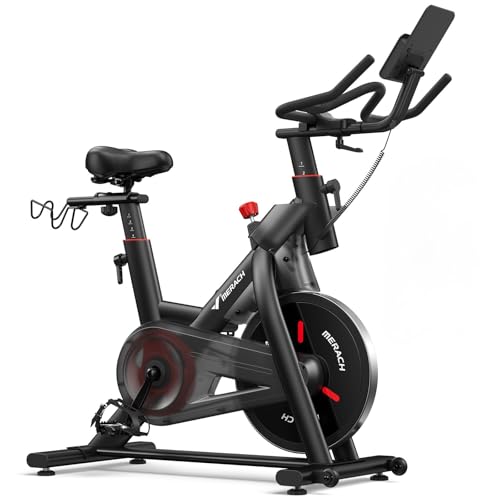
- Self-powered magnetic resistance
- 350-pound weight capacity
- Merach App with health-data syncing
Best For: Quiet, outlet-free connected training at home
Best Value App Bike

- Bluetooth app training support
- Four-way seat adjustment
- Quiet belt-driven ride
Best For: Shared home workouts with basic connected features
Best for Resistance Range

- Kinomap-compatible virtual training
- 0–100% adjustable resistance
- Stable 300-pound-capacity frame
Best For: App-based workouts with highly adjustable intensity
Best App-Connected Stability

- MERACH, KINOMAP, Zwift, Apple Health, and Google Fit support
- Quiet magnetic resistance with 0–100% micro-adjustment
- Reinforced 300-pound-capacity frame
Best For: Families and apartment users wanting a quiet, connected bike
Best High-Capacity Versatility

- 350-pound capacity with reinforced stabilizing frame
- Zwift and Kinomap compatibility
- 100-level resistance plus arm bands for full-body workouts
Best For: Heavier riders wanting versatile connected home training
Versatile Connected Ride – Schwinn IC4
The Schwinn IC4 is a strong all-around choice among connected spin bikes, pairing 100 micro-adjustable magnetic resistance levels with compatibility for popular cycling apps such as Peloton and Zwift. Its console also tracks core ride metrics without requiring a subscription for basic bike use.
Best For: Riders who want flexible app compatibility, quiet magnetic resistance, and a broad range of resistance settings.
Pros:
- 100 micro-adjustable magnetic resistance levels support precise intensity changes.
- Works with Peloton and Zwift apps; separate subscriptions are required.
- Includes dual-sided SPD clip and toe-cage pedals, a tablet holder, dumbbells, and USB charging.
- Supports riders up to 330 pounds and includes a 10-year frame warranty.
Cons:
- Assembly is required.
- App memberships are separate purchases.
- The bike weighs 112 pounds, so repositioning it may take effort.
The IC4 stands out for riders who want to choose their training platform rather than commit to one ecosystem. Its substantial weight, wide resistance range, and app connectivity make it a practical home setup for both structured workouts and self-guided rides.
Quiet Smart Training – MERACH Magnetic Bike
The MERACH magnetic-friction bike is one of the more apartment-friendly connected spin bikes, using a belt drive designed to keep operating noise below 25dB. Bluetooth app connectivity, adjustable positioning, and a 300-pound capacity make it suited to a range of home users.
Best For: Apartment dwellers and beginners who want quiet indoor cycling with MERACH, KINOMAP, or Zwift connectivity.
Pros:
- Designed for noise levels below 25dB with a multi-slot silent belt drive.
- Connects with the MERACH app, KINOMAP, and Zwift, and can sync data with Google Fit and Apple Health.
- Four-way adjustable padded seat and two-way adjustable handlebars accommodate users from 4’8″ to 6’2″.
- 300-pound capacity, transport wheels, leveling knobs, and 80% pre-assembly simplify home setup.
Cons:
- Uses friction resistance rather than magnetic resistance.
- The display focuses on basic metrics such as time, speed, distance, and calories.
- Only a one-year warranty is listed.
MERACH combines a relatively quiet ride with useful app support and a practical adjustment range. It is a sensible pick for shared living spaces, though riders seeking advanced built-in training features may need to rely more heavily on a connected app.
Premium Studio Experience – Peloton Cross Training Bike
The Peloton Cross Training Bike brings a large rotating touchscreen and a broad range of workouts to the connected spin bikes category. Its 21.5-inch display rotates 360 degrees for cycling, strength, yoga, Pilates, barre, and other training sessions, while manual magnetic resistance provides 100 levels.
Best For: Households seeking an integrated Peloton workout platform for cycling and off-bike training.
Pros:
- 21.5-inch Full HD touchscreen rotates 360 degrees for cross-training.
- Offers personalized plans, recommendations, live classes, and on-demand content through the All-Access Membership.
- 100 levels of manual magnetic resistance and Bluetooth 5.2 connectivity support structured training.
- Adjustable seat and handlebars fit riders from 4’11” to 6’5″ and support up to 297 pounds.
Cons:
- The listed All-Access Membership costs $49.99 per month to unlock the full content and applicable features.
- At 178 pounds, the bike is extremely heavy to move or assemble.
- Wi-Fi is required, and clearance is recommended around all sides.
This model is best viewed as a complete connected fitness station rather than a basic exercise bike. The rotating screen adds meaningful versatility, but the subscription cost, network requirement, and heavy build should be considered before purchase.
Heavy-Duty Quiet Ride – 400LB Magnetic Exercise Bike
This heavy-duty model targets riders who prioritize stability, adjustment range, and quiet operation in connected spin bikes. Its reinforced 79-pound frame, magnetic resistance system, heart-rate sensors, and Zwift and KINOMAP compatibility create a sturdy home-training setup.
Best For: Larger or taller riders who want a stable, quiet bike with basic performance tracking and virtual-route app compatibility.
Pros:
- 400-pound capacity and reinforced frame are designed for demanding home workouts.
- Magnetic resistance operates below 25dB for quieter early-morning or late-night sessions.
- Four-way seat and handlebar adjustments accommodate users from 4’8″ to 6’4″.
- Includes handlebar pulse sensors, an LCD display, Zwift and KINOMAP compatibility, and 80% pre-assembly.
Cons:
- The supplied notes do not specify the number of resistance levels.
- The heavy-duty frame may make the bike less convenient to reposition.
- App compatibility is listed, but the notes do not describe included app memberships or subscriptions.
For buyers who need a higher weight capacity and a firm, low-noise platform, this bike has a clear practical advantage. Its app support and heart-rate monitoring add useful feedback, while the substantial frame favors stability over portability.
Best Self-Powered Pick – Merach Magnetic Exercise Bike
For shoppers seeking connected spin bikes without relying on an electrical outlet, the Merach Magnetic Exercise Bike stands out for its pedal-powered design, app connectivity, and quiet magnetic resistance. It tracks workout data through the Merach App and supports Apple Health and Google Fit syncing.
Best For: Home users who want quiet, app-connected training with no charging or outlet requirement.
Pros:
- Self-powered system needs no electrical outlet or battery replacements.
- Supports up to 350 pounds and uses a reinforced steel frame.
- Merach App tracks resistance, distance, time, and calories in real time.
- Quiet magnetic system operates below 25 dB.
Cons:
- The supplied notes do not indicate a built-in screen for displaying workout metrics.
- Its 79-pound weight may make moving it between rooms less convenient.
The Merach is a strong choice when low noise, higher weight capacity, and connected tracking matter more than a fully electric console. Its self-powered setup also adds flexibility for home or outdoor use.
Best Value App Bike – YOSUDA Exercise Bike
The YOSUDA Exercise Bike is a practical option among connected spin bikes for shoppers who want app-supported training without giving up basic ride adjustability. Its belt drive, 25-pound flywheel, LCD display, and Bluetooth-enabled app support cover everyday indoor workouts.
Best For: Budget-conscious riders who want adjustable fit, ride data, and app-based training scenarios.
Pros:
- Bluetooth app support includes riding scenarios and cycling competitions.
- Four-way adjustable padded seat and two-way adjustable handlebars help accommodate different riders.
- Belt-driven design is intended to provide a smoother, quieter ride.
- Includes a tablet holder, LCD display, and tools for assembly.
Cons:
- Its 300-pound capacity is lower than the Merach model in this roundup.
- The supplied details identify app connectivity but do not specify health-platform syncing.
- The power source is listed as battery powered.
YOSUDA makes sense for households sharing a bike, especially when adjustable positioning and a simple LCD readout are priorities. It offers useful connected features while keeping the overall setup focused on straightforward indoor cycling.
Best for Resistance Range – CHAOKE Quiet Magnetic Bike
The CHAOKE Quiet Adjustable Magnetic Resistance Bike is aimed at riders who want connected spin bikes with a broad intensity range. It works with apps such as Kinomap for virtual training, racing, and challenges, while its magnetic resistance adjusts from warm-up levels through harder strength-focused sessions.
Best For: Riders who prioritize wide resistance adjustment, virtual training, and a stable frame.
Pros:
- App-compatible with Kinomap for virtual training, racing, and challenges.
- 0–100% adjustable magnetic resistance supports gradual intensity changes.
- Triangular and H-shaped construction is designed for stability during harder workouts.
- Fits users from approximately 4.7 to 5.9 feet and supports up to 300 pounds.
Cons:
- The stated height range may be less suitable for riders outside approximately 4.7–5.9 feet.
- The supplied notes do not specify broader health-app syncing.
- A one-year warranty is shorter than some buyers may prefer for long-term equipment coverage.
Choose the CHAOKE if resistance flexibility and app-based challenges are central to your routine. Its stable construction and quiet magnetic system make it a compelling fit for focused home cardio, particularly for smaller riders within its listed height range.
Best App-Connected Stability – MERACH S26 Exercise Bike
The MERACH S26 is one of the more feature-rich connected spin bikes for home training. Its Bluetooth app support works with the MERACH app, KINOMAP, and Zwift, while Apple Health and Google Fit syncing helps consolidate workout data. A reinforced steel frame, quiet magnetic resistance, and broad adjustability round out the setup.
Best For: Families and apartment users who want app-connected workouts, quiet operation, and a sturdy 300-pound-capacity bike.
Pros:
- Works with the MERACH app, KINOMAP, Zwift, Apple Health, and Google Fit.
- Reinforced frame supports up to 300 pounds and is designed to reduce flex.
- Quiet magnetic resistance is rated below 25dB, with 0–100% micro-adjustment.
- Includes an adjustable seat and handlebars, tablet holder, dumbbell rack, and dual bottle holders.
Cons:
- The display and included accessories may not replace a dedicated tablet or phone for app workouts.
- Its 62-pound weight and roughly 43-inch depth require a designated workout area.
The S26 is a practical choice when connected training and a stable, quiet ride matter more than a built-in touchscreen. Its generous adjustment range and included storage features make it suitable for shared home use.
Best Value App Connectivity – OLIXIS Smart Exercise Bike
The OLIXIS is a straightforward option among connected spin bikes, pairing Bluetooth app compatibility with a quiet belt drive and digital tracking. It supports FITSHOW, KINOMAP, and Zwift, while its heavy-duty oval steel frame is rated for riders up to 300 pounds.
Best For: Budget-conscious riders who want app access, basic workout metrics, and a cushioned seat for indoor cycling.
Pros:
- Compatible with FITSHOW, KINOMAP, and Zwift.
- Thickened oval steel frame supports up to 300 pounds.
- Quiet belt-drive design is suited to apartments and nighttime workouts.
- Spring-suspension PU seat and adjustable handlebar and seat dimensions improve riding comfort.
Cons:
- The listed specification provides four resistance levels, offering less stated adjustment than some competitors.
- At 54 pounds, it may feel less substantial than heavier frames during intense standing efforts.
- The notes do not specify automatic resistance control through the connected apps.
The OLIXIS focuses on the essentials: app compatibility, quiet operation, a supportive seat, and a sturdy weight rating. It is a sensible pick for casual or developing riders who do not need advanced resistance automation.
Best High-Capacity Versatility – SLUNSE 6-in-1 Exercise Bike
The SLUNSE 6-in-1 is built for riders who want connected spin bikes with more workout variety. In addition to Zwift and Kinomap compatibility, it offers multiple riding positions, arm resistance bands, a 35-pound flywheel, and 100-level magnetic resistance. Its 350-pound capacity is the highest in this group.
Best For: Heavier riders and home users who want full-body training options, high-capacity construction, and app-compatible cycling.
Pros:
- Supports up to 350 pounds with a thickened steel frame, curved rear base, and adjustable feet.
- Works with Zwift and Kinomap for more interactive training.
- Offers 100-level micro-adjustment magnetic resistance and a quiet belt drive rated at 25dB.
- Includes mountable arm resistance bands, adjustable seat and handlebars, tablet holder, and water bottle holder.
Cons:
- The feature-rich design may require more setup and space than a basic exercise bike.
- The notes do not indicate Apple Health or Google Fit syncing.
- Its 35-pound flywheel and heavier-duty frame may make moving or repositioning the bike less convenient.
The SLUNSE stands out for capacity and versatility rather than minimalist design. Its combination of app compatibility, full-body accessories, and finely adjustable resistance makes it a strong fit for varied home workouts.
How We Picked the Best Connected Spin Bikes
We focused on the features that matter most during regular home use: resistance control, stability, rider fit, app compatibility, noise, maintenance, and stated weight capacity. The lineup includes bikes designed for guided classes, performance-focused training, general cardio, and budget-conscious home gyms.
Because app support varies, we considered whether a bike offers built-in controls, Bluetooth or heart-rate compatibility, access to third-party training platforms, or simply a basic companion app. We also looked for practical details such as transport wheels, device holders, emergency stops, and adjustment range.
Quick Comparison
- Best for immersive classes: Peloton Exercise Bikes, Indoor Stationary Cross Training Bikes for Home Item.
- Best for established bike design: Schwinn Fitness IC Indoor Cycling Bike Series.
- Best for app-focused value: MERACH and Merach magnetic exercise bike models.
- Best for heavier riders: The 400-pound and 350-pound-capacity magnetic bikes, subject to verifying the exact model specifications.
- Best for quieter training: Magnetic-resistance models, including the CHAOKE, YOSUDA, OLIXIS, and MERACH options.
Key Buying Factors for Connected Spin Bikes
Resistance and Ride Feel
Magnetic resistance is typically quieter and requires less routine upkeep than friction resistance. Friction systems can still provide effective workouts, but they may produce more sound and require occasional pad replacement. Check whether resistance is manually adjusted or electronically controlled before expecting automatic changes during classes.
App Compatibility and Tracking
“App compatible” does not always mean the bike includes a complete training subscription. Confirm which metrics transmit, whether Bluetooth pairing is supported, and whether the bike works with your preferred platform. A tablet holder may be enough if you plan to stream classes separately, while integrated controls are more useful for interactive training.
Fit, Stability, and Capacity
Measure the bike’s inseam range, handlebar adjustment, footprint, and ceiling clearance before ordering. A heavier flywheel or sturdy frame may improve stability, but it can also make the bike harder to move. Treat advertised weight capacity as a starting point and prioritize a rigid frame, secure pedals, and comfortable contact points.
Noise, Maintenance, and Safety
Magnetic bikes are generally a strong choice for apartments or shared spaces, though drivetrain and floor noise still vary. Use a protective mat, keep fasteners tight, and choose a model with an emergency-stop mechanism and adjustable leveling feet when possible.
Who Should Buy Which Connected Spin Bikes?
Choose Peloton if live and on-demand classes, polished software, and a cohesive training ecosystem are your top priorities. Choose Schwinn if you want a recognizable indoor-cycling platform with broad training flexibility.
Choose MERACH, Merach, YOSUDA, CHAOKE, or OLIXIS if you want app-assisted workouts and quiet magnetic resistance without committing to a premium connected ecosystem. Choose a high-capacity model if published capacity, frame stability, and fit align with your needs—but verify the exact listing, since similarly named bikes can have different specifications.