The right spin bike for a home gym can make indoor cycling more convenient, consistent, and comfortable. These 10 selected models cover a range of priorities, including quiet magnetic resistance, app compatibility, built-in screens, adjustable fit, and higher weight capacities.
Use the guide below to compare the features that matter most before choosing a bike for steady cardio, interval training, or structured cycling workouts at home.
Best 10 Spin Bike for Home Gym Picks for 2026
Best Overall Value

- Quiet magnetic resistance for shared spaces
- 300-pound capacity with broad seat adjustment
- Heart-rate tracking and app compatibility
Best For: Families wanting versatile, low-noise home cardio
Best for App Training

- Under-25-dB magnetic and belt-driven ride
- YPOOFIT, KINOMAP, and Zwift support
- 300-pound capacity with comfort-focused adjustments
Best For: Beginners and riders who prefer guided digital workouts
Best Compact Choice

- Compact design for apartments and small rooms
- Quiet belt-driven operation below 25 dB
- Shock-absorbing seat and broad resistance adjustment
Best For: Space-conscious users and everyday indoor cardio
Best Premium Display
MERACH Connected Exercise Bike

- 21.5-inch rotatable HD display
- Automatic magnetic resistance for guided courses
- 330-pound capacity with app and health-data syncing
Best For: Riders seeking an immersive, connected training experience
Quiet Budget Pick

- 25-pound flywheel and belt drive
- Adjustable seat and handlebars
- LCD, tablet holder, and app support
Best For: Quiet everyday home cycling
Connected Comfort Choice
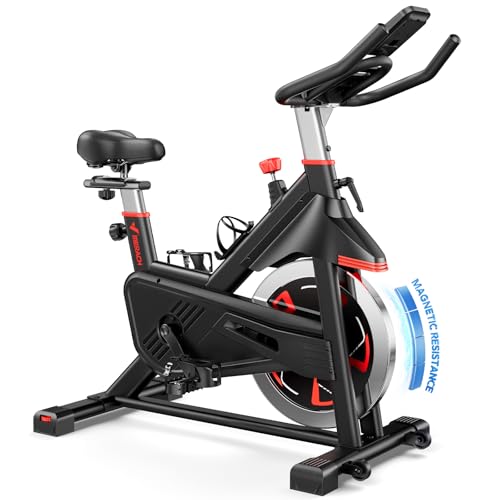
- App tracking with third-party syncing
- 0–100% resistance range with app levels
- Comfort-focused seat and 300-pound frame
Best For: App-guided, comfortable home workouts
Best Resistance Range
Superun 32-Level Exercise Bike

- 32 levels of magnetic resistance
- 300-pound heavy-duty steel frame
- LCD metrics and transport wheels
Best For: Fine-tuned resistance and shared home use
Quiet Smart Pick
MERACH Magnetic Friction Spin Bike

- Below-25dB belt-drive operation
- App support for KINOMAP and Zwift
- 300-pound capacity with broad adjustability
Best For: Quiet, connected home workouts
Durable Magnetic Trainer
CHAOKE Adjustable Magnetic Spin Bike

- Quiet magnetic resistance
- Reinforced 300-pound-capacity frame
- Kinomap-compatible virtual training
Best For: Stable workouts for smaller riders
Best Overall Value – Quiet Magnetic Spin Bike
If you want a versatile spin bike for home gym workouts, this model combines quiet magnetic resistance, app connectivity, and a sturdy 300-pound capacity. Its enclosed flywheel and compact design also make it practical for shared households.
Best For: Families seeking a quiet, adjustable indoor bike with basic smart-training features.
Pros:
- Magnetic resistance provides smooth, whisper-quiet operation.
- Supports up to 300 pounds and fits users from 4’8″ to 6’2″.
- Tracks heart rate and six workout metrics, with Kinomap, Zwift, and Fitshow support.
- Fully enclosed wheel cover and transport wheels improve household safety and portability.
Cons:
- The product details list a corded electric power source, which may limit placement flexibility.
- Its smart features depend on compatible apps and devices.
This bike stands out as a balanced option for households that want quiet cardio, a strong frame, and convenient monitoring without moving into a more elaborate connected-bike setup.
Best for App Training – YPOO Magnetic Spin Bike
The YPOO is a strong choice if your spin bike for home gym routine is built around guided classes and interactive rides. It offers magnetic resistance, multiple app connections, and a stable frame while arriving mostly assembled.
Best For: Beginners and motivated riders who want app-based courses, challenges, and interactive training.
Pros:
- Runs below 25 dB with a belt drive and maintenance-free magnetic system.
- Connects with the YPOOFIT app, KINOMAP, and Zwift.
- Offers a 4-way adjustable seat, adjustable handlebars, and 16 resistance levels.
- Supports up to 300 pounds and includes transport wheels, bottle holders, and a tablet holder.
Cons:
- The listed fit range ends at 6’1″, which may not suit taller riders.
- App-based features require compatible devices and connectivity.
With its comfortable setup, near-silent operation, and broad app support, the YPOO is particularly appealing for riders who stay consistent through structured digital workouts.
Best Compact Choice – RELIFE Friction Exercise Bike
For smaller rooms, the RELIFE offers a practical spin bike for home gym use with a compact footprint, quiet belt-driven operation, and a wide resistance range. Its shock-absorbing seat is designed to make longer indoor sessions more comfortable.
Best For: Apartment dwellers, beginners, and households needing a compact bike for everyday cardio.
Pros:
- Operates below 25 dB for early or late workouts.
- 0–100% adjustable resistance supports gentle warmups and harder training.
- Six-way seat and six-level handlebar adjustments accommodate users from 4’8″ to 5’8″.
- Includes cage pedals, an iPad mount, LED display, and transport wheels.
Cons:
- The 280-pound capacity is lower than several alternatives in this roundup.
- The listed height range may be limiting for taller users.
- Its friction resistance may require more maintenance than magnetic systems.
The RELIFE is best viewed as a space-conscious, comfort-oriented option. It delivers useful adjustability and quiet performance, provided its shorter fit range and friction mechanism match your needs.
Best Premium Display – MERACH Connected Exercise Bike
The MERACH brings a more immersive approach to the spin bike for home gym category with a rotatable 21.5-inch HD display, app-based courses, and automatic resistance control. Its reinforced frame and 330-pound capacity suit riders who want a substantial connected-bike experience.
Best For: Riders who prioritize a large screen, guided courses, and automatic resistance adjustments.
Pros:
- 21.5-inch anti-glare display swivels and tilts for flexible viewing.
- Automatic magnetic resistance can follow compatible expert courses.
- Supports up to 330 pounds and fits users from 4’8″ to 6’4″.
- Tracks workout data through the MERACH app and can sync with Google Fit and Apple Health.
Cons:
- The product notes say it is currently incompatible with Google phones.
- At 66 pounds, it is heavier than the other listed bikes.
- The larger screen and 43.2-inch depth require more dedicated floor space.
If you want your home rides to feel closer to a studio workout, the MERACH offers the most immersive interface here. Check device compatibility and available space before buying.
Quiet Budget Pick – YOSUDA Magnetic Exercise Bike
If you want a practical spin bike for home gym workouts, the YOSUDA combines a belt drive, 25-pound flywheel, and adjustable magnetic/friction resistance in a compact indoor setup. Its 300-pound capacity and app connectivity add flexibility for regular rides.
Best For: Home users who want a quiet, adjustable bike with basic ride tracking and app-supported training.
Pros:
- Belt-driven system is designed for a smoother, quieter ride.
- Four-way adjustable padded seat and two-way handlebars fit users from 4’8″ to 6’0″.
- LCD tracking, tablet holder, Bluetooth app support, and 300-pound capacity.
- Assembly tools and instructions are included, with an online assembly video.
Cons:
- The display and app connectivity require battery power.
- Its 25-pound flywheel may be less substantial than heavier commercial-style options.
The YOSUDA is a sensible choice when quiet operation, adjustability, and straightforward home use matter more than advanced built-in training features.
Connected Comfort Choice – MERACH Magnetic Exercise Bike
The MERACH is a feature-rich spin bike for home gym use, pairing magnetic resistance with a self-developed app, real-time workout data, and a reinforced frame. Its wide seat, suspension design, and quiet belt transmission make it suited to longer indoor rides.
Best For: Riders who value app-connected metrics, highly adjustable resistance, and extra seat comfort.
Pros:
- Magnetic resistance ranges from light riding to intense efforts, with 16 levels shown in the app.
- App tracks resistance, distance, time, and calories and can sync with Google Fit and Apple Health.
- Four-way seat and two-way handlebar adjustment accommodates users from 4’8″ to 6’2″.
- Dual-triangle frame supports up to 300 pounds, while the belt system is rated below 25 dB in testing.
Cons:
- Some resistance-level information is displayed only within the Merach app.
- At 58 pounds, it may be less convenient to move than lighter bikes.
Choose the MERACH if connected tracking and a more cushioned riding experience are priorities. It also includes assembly guidance and a 12-month warranty for added support.
Best Resistance Range – Superun 32-Level Exercise Bike
For shoppers comparing a spin bike for home gym workouts, the Superun stands out with 32 levels of magnetic resistance, a heavy-duty steel frame, and simple onboard tracking. Built-in transport wheels also make it easier to reposition after training.
Best For: Families or home-gym users who want fine resistance control, a sturdy frame, and convenient storage.
Pros:
- 32 magnetic resistance levels support recovery rides through climb-style workouts.
- Heavy-duty steel frame supports up to 300 pounds.
- Four-way seat and two-way handlebars fit users from approximately 4.6′ to 6.1′.
- LCD monitor tracks time, speed, distance, calories, and RPM; transport wheels aid repositioning.
Cons:
- It lacks the app connectivity highlighted on some competing models.
- The listed power source is corded electric, which may limit placement flexibility.
The Superun is a straightforward option for riders who prefer physical resistance control and clear metrics over connected training features. Its compact dimensions and transport wheels are useful in smaller home gyms.
Quiet Smart Pick – MERACH Magnetic Friction Spin Bike
The MERACH is a practical spin bike for home gym use when quiet operation, app connectivity, and broad adjustability matter. Its belt drive is rated below 25dB, while the companion app tracks workout metrics and works with KINOMAP and Zwift.
Best For: Apartment dwellers, early or late exercisers, and users who want app-connected tracking with a sturdy 300-pound-capacity frame.
Pros:
- Quiet belt-drive operation and infinitely adjustable friction resistance.
- Bluetooth app support with compatibility for KINOMAP, Zwift, Google Fit, and Apple Health.
- Adjustable seat and handlebars accommodate users from 4’8″ to 6’2″.
- Includes transport wheels, leveling knobs, caged pedals, and dual bottle holders.
Cons:
- Uses friction resistance rather than magnetic resistance.
- Its 27 kg weight and 40-inch depth may require a dedicated workout area.
With a 300-pound capacity, triangular frame, and 80% pre-assembled delivery, this MERACH bike offers a balanced feature set for regular home cycling. The one-year warranty adds useful ownership support.
Comfort-Focused Value – OLIXIS App-Controlled Spin Bike
The OLIXIS is a spin bike for home gym setups that prioritizes a stable frame, quiet belt-driven training, and app compatibility. Its cushioned, spring-suspension seat is especially useful for riders planning longer indoor cycling sessions.
Best For: Home users seeking a budget-conscious bike with a 300-pound capacity, shock-absorbing seat, and compatibility with popular cycling apps.
Pros:
- Thickened oval steel frame supports up to 300 pounds.
- Compatible with FITSHOW, KINOMAP, and Zwift for connected training.
- Quiet belt drive and adjustable resistance suit apartment or nighttime workouts.
- PU seat with spring suspension is designed for added comfort.
Cons:
- The listed specification identifies four resistance levels, fewer than some competing bikes.
- The height range may be less suitable for especially short or tall riders.
The OLIXIS combines basic digital tracking with a stable steel construction and comfort-oriented seat. It is a sensible choice for steady cardio, though buyers wanting highly granular resistance control should review the four-level specification carefully.
Durable Magnetic Trainer – CHAOKE Adjustable Magnetic Spin Bike
The CHAOKE is a spin bike for home gym users who want quiet magnetic resistance, a reinforced frame, and app-compatible training. Its resistance adjusts from warm-up intensity through harder strength-focused sessions, making it suitable for varied routines.
Best For: Smaller riders and families wanting a stable, quiet bike with a 300-pound capacity and virtual-training compatibility.
Pros:
- Magnetic resistance delivers a quiet ride with reduced wear.
- Triangular and H-shaped construction is designed for stability.
- App compatibility includes Kinomap for virtual training and challenges.
- Thick steel construction and electrophoretic rust protection support durability.
Cons:
- Its stated fit range of 4.7 to 5.9 feet may not suit taller users.
- The supplied notes do not specify a built-in pulse monitor or a full console feature list.
With a 300-pound capacity, quiet magnetic system, and reinforced frame, the CHAOKE emphasizes stability and long-term use. Its relatively compact rider range makes checking fit especially important before purchase.
How We Picked the Best Spin Bike for Home Gym
We focused on the features that have the greatest effect on everyday indoor cycling: resistance type and adjustability, frame stability, rider capacity, fit customization, noise level, display and app support, and overall convenience. Magnetic resistance received particular attention because it generally provides quieter, smoother operation than friction systems and requires less direct contact with the flywheel.
We also considered whether each bike suits a specific type of home user, from beginners who want simple cardio equipment to experienced riders who value structured training, heavier-duty construction, or connected workout features.
Quick Comparison
- Best for quiet workouts: Choose a magnetic-resistance model with a stable frame and smooth adjustment range.
- Best for guided training: Look for app compatibility, built-in workout programs, or an integrated display.
- Best for larger riders: Prioritize a clearly stated weight capacity, reinforced construction, and a wide adjustment range.
- Best for budget-conscious buyers: A simpler bike with manual resistance and a basic performance monitor may offer the best value.
Key Buying Factors for a Spin Bike for Home Gym Use
Resistance and Ride Feel
Magnetic resistance is a strong choice for shared spaces, early-morning sessions, and apartments because it operates quietly. Friction resistance can still provide a familiar road-bike feel, but the pad may wear over time and usually requires more maintenance. Consider how precisely you want to control intensity, especially if you plan to perform intervals.
Fit and Adjustability
Check whether the seat height, seat position, and handlebars adjust in the directions you need. A proper fit helps reduce strain on the knees, hips, back, and wrists. If multiple people will use the bike, prioritize broad adjustment ranges and easy-to-change settings.
Stability, Capacity, and Footprint
A heavier base and levelers can improve stability during hard efforts. Compare the listed rider capacity with your weight rather than selecting a bike that only barely meets it. Measure your available floor space and leave room to mount, dismount, and move the bike safely.
Displays, Apps, and Connectivity
Decide whether you need a built-in screen or simply a basic monitor for time, speed, distance, and calories. App-compatible bikes can support classes and training plans, but verify which features require a subscription and whether your preferred phone or tablet is supported.
Who Should Buy Which Spin Bike for Home Gym?
Beginners should choose an easy-to-adjust bike with straightforward controls, dependable stability, and a comfortable saddle. Apartment dwellers will generally benefit from a quiet magnetic model. Structured-training users should prioritize app support, multiple resistance levels, or a larger integrated display. Taller or heavier riders should focus first on fit range, frame strength, and weight capacity. For occasional cardio, a compact, affordable model may be sufficient; frequent riders should spend more on smoother resistance, better adjustability, and stronger construction.